Quick answer
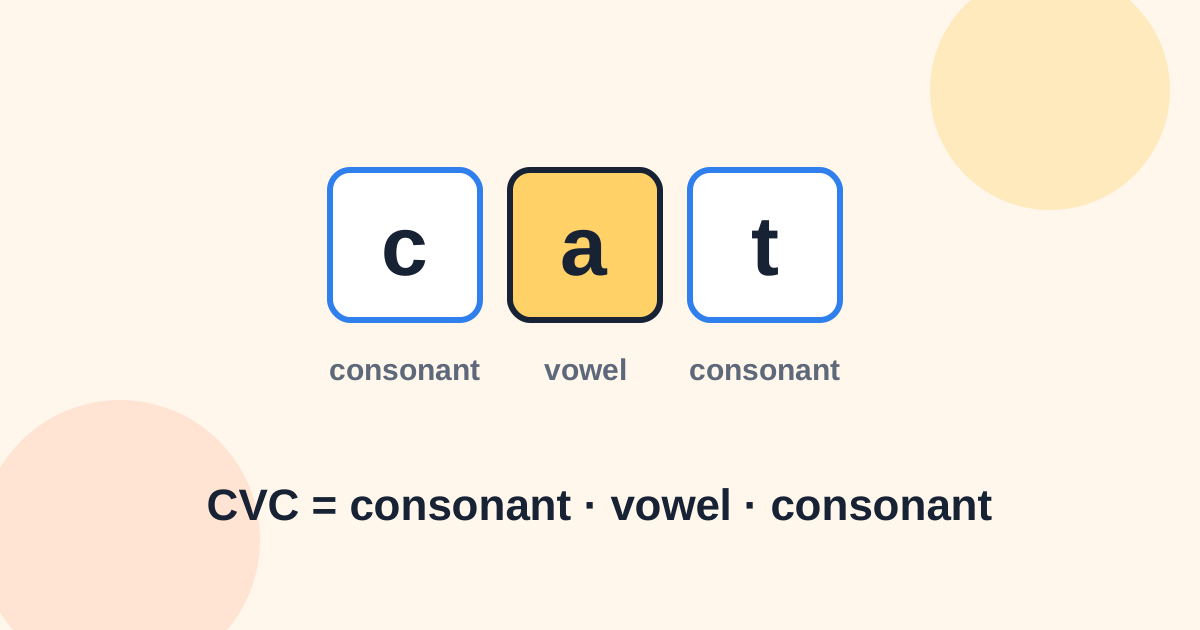
CVC stands for consonant-vowel-consonant. Beginner CVC practice usually uses three-letter, three-sound short-vowel words such as mat, pen, sit, hop, and sun. Teach known letter sounds, model blending from left to right, then connect reading with spelling and short decodable phrases. Three letters do not always mean three sounds: x represents two sounds in fox.
Key takeaways
- Start with three-letter, three-sound words that use spellings your child has already learned.
- Stretch continuous sounds such as /m/ and /s/, but say stop sounds such as /t/ briefly without an extra uh.
- Check the middle vowel and final consonant instead of encouraging picture or first-letter guessing.
- Use word chains, spelling, and matched decodable text; progress depends on the child, not a fixed timetable.
CVC words give beginning readers a manageable way to connect speech sounds with print. A child who reads mat by following all three letters is learning a strategy that can transfer to unfamiliar words, rather than remembering one card. The useful question is not how many words a child can finish today, but whether the child can use the letter sounds to work out a word without guessing.
What counts as a CVC word?
CVC stands for consonant-vowel-consonant. In beginner teaching materials, the label usually refers to short-vowel words with three letters and three sounds, such as mat, pen, and sun. Each letter represents one phoneme, or individual speech sound. These are especially convenient for introducing sound boxes, letter tiles, and left-to-right blending.
Materials sometimes use CVC to describe a letter pattern and sometimes a sound pattern. Those are not always identical. Ship has three sounds, because sh represents one sound, but it requires a digraph that a beginner may not yet know. Fox has three letters but four sounds: /f/, the short-o vowel, /k/, and /s/. The same issue applies to box and mix. Keep those out of an introductory three-sound set. Choose words according to the spellings taught, not merely their length.
CVC word examples by short vowel
This table groups straightforward practice words by their middle vowel. It is a resource for choosing a small set, not a list to complete in one sitting. Use your family's natural pronunciation and follow the teacher's sound examples; vowel pronunciations differ across English accents. In this guide, labels such as short a refer to teaching categories rather than a full phonetic transcription.
| Vowel | Example words | Possible first pair | What to notice |
|---|---|---|---|
| Short a | mat, sat, fan, nap, bag, cat | mat, sat | The vowel sound stays the same when the first consonant changes. |
| Short e | men, pen, hen, ten, net, bed | men, pen | Use a familiar spoken word to anchor the vowel. |
| Short i | sit, pin, fin, lip, dig, win | pin, fin | Attend to the middle sound, not only the first letter. |
| Short o | mop, top, hop, pot, log, dog | mop, top | Model the short vowel used in the child's local speech. |
| Short u | sun, run, fun, cup, mud, bug | sun, run | Keep the vowel distinct from its letter name. |
Before practice: choose words the child can access
A child does not need the entire alphabet before trying a few printed words. Start with known letter-sound correspondences and one familiar short vowel. If m, s, a, and t have been taught, mat and sat offer useful practice. Introducing an unfamiliar vowel, a new consonant, and blending at the same time makes it harder to identify what needs help.
Briefly check the component skills. Point to the letters separately and ask for sounds, not names. Then say the sounds of a familiar word and model joining them. Oral blending and printed-word reading are related but different tasks. Practice them together with support rather than treating oral mastery as a reason to postpone all contact with print.
A five-step CVC blending routine
1. Show and model a continuous starting sound
Write man clearly. Point under m and say /m/, then move into the short-a sound and finish with /n/. Sounds such as /m/, /s/, and /f/ can be sustained. This makes them useful starting points for a blending demonstration. The child watches you first, joins in, then tries the word with less help.
2. Connect sounds without adding an extra vowel
Slide your finger under the letters as you blend. Do not turn /m/ into “muh,” or /t/ into “tuh.” Stop consonants such as /p/, /t/, and /k/ cannot be stretched like /m/. Say them briefly and connect to the adjacent vowel. For mat, sustain the beginning and vowel if needed, then finish with a brief /t/; do not stretch the final consonant into another syllable.
3. Say the whole word naturally
After blending, say man normally and check its meaning in a spoken sentence. Meaning confirms the decoded word; it should not replace looking at the letters. If the child says mat instead, point to the last letter and model the correction before asking for another attempt.
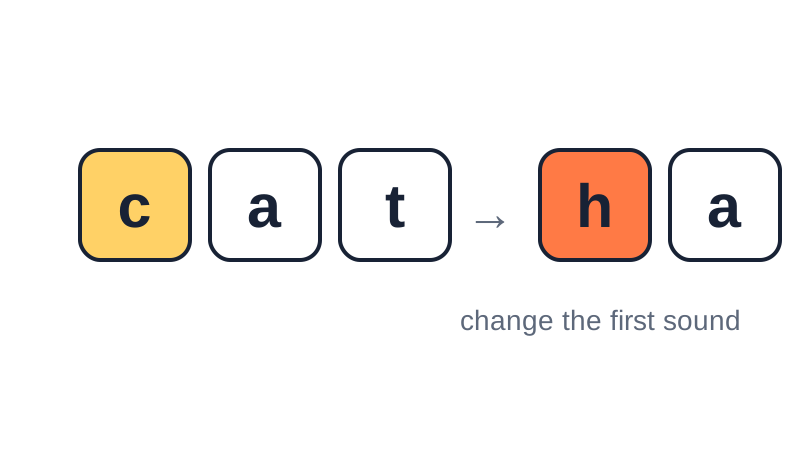
4. Change one letter and reread
Use a short chain such as mat → sat → sit → sip, introducing the vowel change only if short i has been taught. Ask which letter changed and which sound changed. Read each new word from the beginning. Later shuffle the cards so the child cannot answer solely by remembering the order.
5. Read a matched phrase
Move into a phrase such as a red hen once its component spellings and the word a have been taught. A sentence that looks short is not necessarily decodable for this child. For example, the requires additional teaching. Our guide to sight words and high-frequency words explains how to connect regular spellings with the parts that need attention.
If the child knows sounds but cannot blend
Repeatedly saying “sound it out” does not show a child how to join sounds. Compare what happens when you supply the sounds with what happens when the child reads the letters. This is a practical observation, not a diagnosis. Use the response to simplify the next task and share concrete examples with the teacher.
| What you notice | A useful next attempt | What to avoid |
|---|---|---|
| The child names letters instead of saying sounds. | Briefly model the taught sound for each letter, then reread one word together. | Adding a large new word list. |
| Sounds are correct but remain separate. | Use man or sun; connect the first two sounds before adding the last. | Long pauses followed by a demand to guess. |
| The middle vowel changes. | Return to a small set with one familiar vowel, then contrast two taught vowels. | Mixing every vowel immediately. |
| The child guesses from the first letter. | Point to each spelling and reread the whole word after correction. | Asking which word the picture suggests. |
| The child reads cards but struggles in a phrase. | Check every word in the phrase and reread a shorter matched phrase. | Assuming the child is careless. |
If a printed word is still difficult, briefly cover its final letter. Help the child blend the first two sounds, then reveal the last and join it on. This is temporary support, not a new guessing strategy. Gradually remove the cover and model reading the complete word. Keep frustration low and seek teacher or reading-specialist guidance when difficulty persists despite clear instruction.
Link CVC reading with spelling and sound boxes
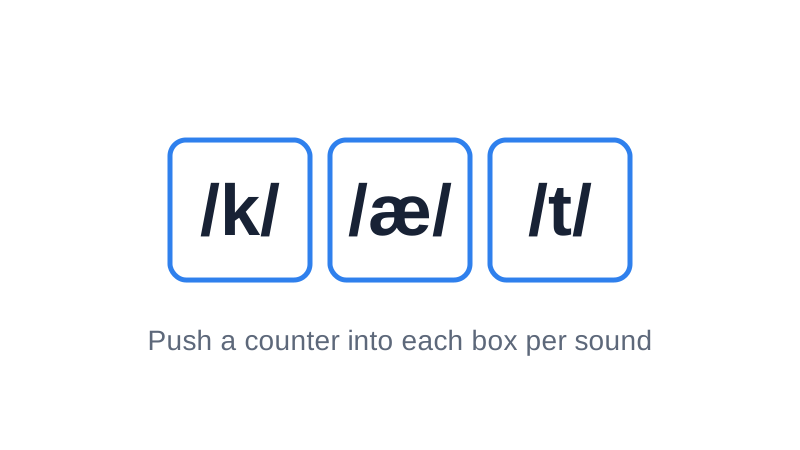
Draw three empty boxes. Say sun and ask the child to move a counter for each sound. Then replace the counters with s, u, and n. Read the completed word, cover it, and let the child build or write it again with support. One box represents a sound, not automatically one letter in every English word.
This distinction explains why word selection matters. Three boxes suit sun; they do not suit fox, which has four phonemes. Later, a digraph such as sh can occupy one sound box, but it needs explicit teaching. Also distinguish sound counting from syllable counting: sun has three phonemes but one spoken beat. See what a syllable is for that separate skill.
A flexible home practice plan
Choose a brief session your child can manage. Review a few known sounds, model one word, read a small mixed set, spell one or two words, and finish with a matched phrase. Five minutes may be enough on a tiring day. The sequence is a suggested routine, not a research-based dosage or promise of progress within a specific number of days.
Record useful observations rather than speed alone: whether the child read independently, needed a model, confused a vowel, or missed the final consonant. Revisit difficult spellings in a later session, alongside familiar examples. Ask the teacher for words and decodable reading that match classroom instruction. Continue sharing richer read-aloud books for vocabulary and enjoyment; not every book must be a decoding exercise.
When to move beyond CVC words
Look for accurate reading across varied words with taught spellings, not just success on one memorized family. When this becomes more comfortable, follow the teaching sequence into additional patterns such as digraphs and consonant blends, while retaining review. CVC reading is one part of literacy, alongside language, spelling, fluency, and comprehension. There is no single age at which every child must complete it.
If digital practice is helpful, compare tools that model sounds clearly, let children blend rather than guess, and show adults which patterns need review. Our phonics app comparison provides selection criteria. An app supplements adult instruction and books; it does not replace individualized support or guarantee a reading outcome.
Frequently asked questions
What does CVC mean?
CVC means consonant-vowel-consonant. For beginner practice, choose short-vowel words such as mat, pen, sit, hop, and sun, with one letter representing each of three sounds.
Are fox and box simple three-sound CVC words?
No. They have three letters, but x represents /k/ and /s/, so each has four phonemes. They may appear on lists organized by letter pattern, but should not be used as three-sound examples.
What if my child knows letter sounds but cannot blend?
Model a word starting with a continuous sound, such as man. Connect the first two sounds, then add the last. Compare oral blending with printed-word reading and ask the teacher for guidance if difficulties persist.
Does my child need to know the whole alphabet first?
No. Begin with words made from a small set of taught letter-sound correspondences. Continue teaching other letters alongside brief, supported word reading.
When should a child move beyond CVC words?
When a child can read varied words with taught spellings and use them in short phrases, introduce the next patterns in the teaching sequence while continuing review. There is no universal age or fixed number of practice days.
Sources and further reading
For blending and segmenting activities and the research behind them, see Reading Rockets: Blending and Segmenting Games. For resources organized around taught skills, including decodable passages and home practice, see the UFLI Foundations Toolbox; its materials accompany the program's lesson plans. The examples, troubleshooting table, and home routine in this guide are our editorial synthesis, not a reproduction of either program. This article offers educational information, not a diagnosis of reading difficulties.
We may earn a commission at no extra cost to you.
Free 7-day phonics starter course
Liked this guide? Get one short, practical phonics email a day for 7 days — written for busy parents.