Quick answer
Sight words are words a reader recognizes accurately and automatically, whereas high-frequency words occur often in print. Teach sound-spelling connections, explain unexpected spellings, and check recognition across days and in sentences rather than relying on card order or word shapes.
Key takeaways
- Sight describes automatic recognition; high-frequency describes how often a word appears in print.
- An untaught phonics pattern is not necessarily an irregular spelling.
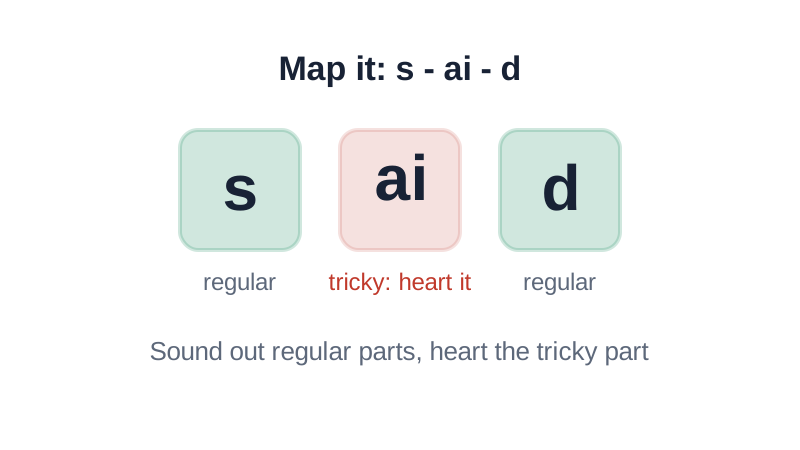
- Connect regular parts to sounds and explicitly explain unexpected parts, such as ai in said.
- Practice reading and spelling with feedback, then check the word in a suitable sentence on another day.
- Word lists and apps support systematic instruction but do not replace it or diagnose reading difficulties.
Quick answer: what are sight words?
Sight words are words a reader recognizes accurately and automatically. They are not a special category of words that must all be memorized as pictures. High-frequency words appear often in print; irregular words contain a spelling that does not follow the pattern a learner expects. These categories overlap, but they mean different things. Teach children to connect spoken sounds with written spellings, explain any unusual part, and revisit the word in meaningful reading and writing.
For example, can can become a sight word through ordinary short-vowel phonics practice. Said can also become a sight word, but its middle spelling needs attention. Recognizing either word without effort is the eventual outcome, not a reason to skip looking at its letters. This guide helps parents choose a small practice set, explain the spelling, and check whether learning carries over beyond a familiar flashcard.
Sight words, high-frequency words, and heart words
A sight word describes a reader's current knowledge. A word that an adult reads instantly may still require slow decoding for a child. High-frequency describes how often a word occurs in a particular collection of text, regardless of whether that child can read it. A list of common words is therefore a planning resource, not proof that every item needs the same teaching method.
Teachers sometimes use heart words for words containing an unexpected spelling that needs to be learned by heart. The useful idea is to identify the unexpected part while still explaining the other sound-spelling connections. Terminology varies across schools. Ask which notation and pronunciation your child's teacher uses so that home practice reinforces rather than competes with classroom instruction.
Also distinguish an unusual spelling from an untaught spelling. A child who knows only short vowels may find see difficult because the vowel team has not been taught yet. That does not make the entire word an exception. For early regular-word practice, our CVC words guide explains how to connect and blend a simple sequence of sounds.
Examples: look inside common words
The table uses sound descriptions rather than a full phonetic transcription. Follow the pronunciation natural to your family and classroom. A pair of letters can represent one sound; do not assume that each written letter requires its own spoken sound.
| Word | What to notice | Teaching move | Short example |
|---|---|---|---|
| can | c represents /k/; a is the short-a vowel; n represents /n/. | Blend the three sounds once the correspondences are known. | I can run. |
| in | Two letters represent two sounds. | Connect the short-i vowel to n without adding extra vowel sounds. | Get in. |
| see | ee works together to represent the long-e vowel. | Teach the vowel team instead of calling the whole word irregular. | I see it. |
| said | s and d are familiar; ai represents the vowel heard in bed. | Mark ai as the unexpected spelling in this word. | Sam said yes. |
| the | th represents one voiced consonant sound; the vowel varies with emphasis and context. | Model the spoken word and connect it to th and e. | The cat ran. |
These are teaching examples, not a universal first-week list. Sentences may contain other patterns your child has not learned. Read those parts together rather than expecting independent reading before instruction. Keep the target word visible and avoid using a picture as the way to identify it.
A worked example: teaching said
First say the word naturally and use it in a sentence the child understands: “Dad said yes.” Ask the child to repeat said. Together, listen for its three sounds: the initial /s/, the vowel heard in bed, and the final /d/. If identifying the sounds is difficult, model the segmentation instead of making this a test.
Next write said. Point to s for the first sound, ai for the middle sound, and d for the last sound. Explain: “In this word, ai spells the vowel we hear in bed.” Underline ai, or place a small heart above it if that matches the school's routine. There are four letters but three sound positions; the a and i belong together for this example.
Have the child read the whole word, then say it and build or write it from memory. Compare their attempt with the model and discuss the spelling rather than simply announcing a score. If handwriting is tiring, letter tiles let the child focus on choosing letters. Return to a short sentence and read it for meaning. This is guided sound-to-spelling practice, not a claim that a single lesson creates permanent automatic recognition.
A short home routine that fits phonics instruction
- Choose a manageable set. Start with one or two words from the current classroom lesson or reading book. This is a practical starting point, not a required number for every age.
- Say the word and discuss its meaning. Some common words are difficult to explain without a sentence. Give a natural example before expecting the child to use the word.
- Listen and connect. Identify the spoken sounds, show their spellings, and explain any untaught or unexpected part. Model what the child cannot yet do independently.
- Read, build, and check. Read the word, cover it briefly, and try building or writing it. Uncover and compare. Correct the specific part that caused trouble.
- Use the word in text. Read a suitable short phrase or sentence, then discuss what it means. Most of the surrounding words should use patterns the child knows.
- Review on another day. Mix the word with familiar examples in a different order. Add new items when the current set feels secure rather than expanding the stack automatically.
A few attentive minutes can be more useful than continuing through frustration. This routine is an optional home supplement, not a replacement for a systematic school program. Keep reading aloud enjoyable books as well: word recognition is only one part of reading, alongside vocabulary, language understanding, and knowledge.
Should you use Dolch or Fry lists?
Dolch and Fry are commonly used high-frequency word lists. They help adults select words children are likely to encounter, but a list is not a phonics scope and sequence. Its order does not necessarily match the sound-spelling patterns your child has learned. Choose the school's list when one is provided, and ask how words should be taught rather than assuming the goal is rapid recitation.
Sort a small batch into three practical groups: readable with known patterns, containing a pattern that has not been taught, and containing an unexpected spelling. This gives you a teaching decision for each word. Do not make a child complete a large list before reading suitable books. Equally, do not treat a grade label on a printable as a diagnosis or a universal deadline for mastery.
When flashcards do not transfer to reading
The child knows the order, not the word. Shuffle a few cards and show one at a time without a picture. If performance changes, return to the spelling and practice in a different order. A memorized sequence can look like fluent reading until the arrangement changes.
The child guesses from the first letter. Point to the whole spelling and compare the guessed word with the printed one. If the child says can for cat, draw attention to the final letter, model the correction, and reread. Encourage accurate looking rather than faster guessing.
The child reads the card but misses it in a sentence. Reduce the surrounding reading load. Model the unfamiliar words, locate the target, and then reread the sentence together. The problem may involve attention or sentence difficulty, so do not conclude that the child has forgotten everything.
The child can read but cannot spell it. Reading recognition and independent spelling place different demands on memory. Practice saying the word, identifying sounds, and selecting spellings, with prompt feedback. A reading success is still a success even when spelling needs more instruction.
Check progress without turning practice into a speed contest
Keep a simple record with the word, date, and support needed. Useful notes include “read independently,” “read after a spelling reminder,” and “needed a model.” Revisit a word in a different sentence or a different card order on a later day. This gives more useful information than counting how many cards were seen during one session.
Look for accurate recognition with decreasing support and growing ability to read the word in text. Do not demand instant responses before the sound-spelling connections are secure. If difficulties persist across classroom and home practice, share specific examples with the teacher or reading specialist. A sight-word score alone cannot identify dyslexia or explain every reading difficulty.
What to look for in a sight-word or phonics app
Prefer activities that show the written word clearly, connect speech to print, give useful correction, and let an adult choose an appropriate level. Check whether the child reads a word or merely taps a remembered picture. Sound effects, badges, and fast responses are not evidence that word reading transfers to a book.
Try a small amount of app practice alongside reading and writing away from the screen. Our phonics app comparison section can help you compare options, but confirm current features, pricing, privacy terms, and cancellation rules with the provider. An app is supplementary practice, not a substitute for individualized instruction when a child needs it.
For related concepts, explore the phonics basics learning hub or browse our parent reading guides. Build a coherent sequence instead of collecting unrelated lists and activities.
Sources and parent guidance
The University of Florida Literacy Institute's Foundations overview describes systematic work on sound-spelling connections, decoding, spelling, irregular words, and connected text. Its Foundations Toolbox provides companion resources for that program. These sources inform the instructional principles here; the examples and home routine above are our own explanation, not an official UFLI lesson or endorsement.
Compliance note: This article provides general educational information, not diagnosis or individualized treatment. Results vary by child, prior instruction, and support. BestPhonicsApp.com may earn a commission from qualifying purchases through affiliate links. No app or practice routine promises a particular reading outcome.
We may earn a commission at no extra cost to you.
Free 7-day phonics starter course
Liked this guide? Get one short, practical phonics email a day for 7 days — written for busy parents.