Quick answer
Phonemic awareness is the ability to hear and work with individual sounds in spoken words. It is an oral skill that supports phonics because children first learn to blend, segment, and manipulate sounds before connecting those sounds to printed letters.
Key takeaways
- Phonemic awareness is about individual speech sounds, not printed letters.
- It is part of phonological awareness, while phonics connects those sounds to print.
- Blending and segmenting are the most practical starting skills for parents.
- The best reading practice connects oral sound work with consonants, vowels, CVC words, and decodable text.
Phonemic awareness is the ability to hear, notice, and work with the individual sounds in spoken words. Those individual sounds are called phonemes. For example, the word map has three phonemes: /m/ /a/ /p/. A child with phonemic awareness can blend those sounds into map, segment map back into its sounds, and notice what changes if /m/ becomes /t/.
This skill is oral. A child can practice phonemic awareness with eyes closed and no letters on the page. Phonics is different: phonics connects those spoken sounds to printed letters and spelling patterns. The two skills are closely related, but they are not the same. Parents often get better results when they practice the spoken sounds first, then connect them to simple printed words.
Phonemic awareness vs phonological awareness vs phonics
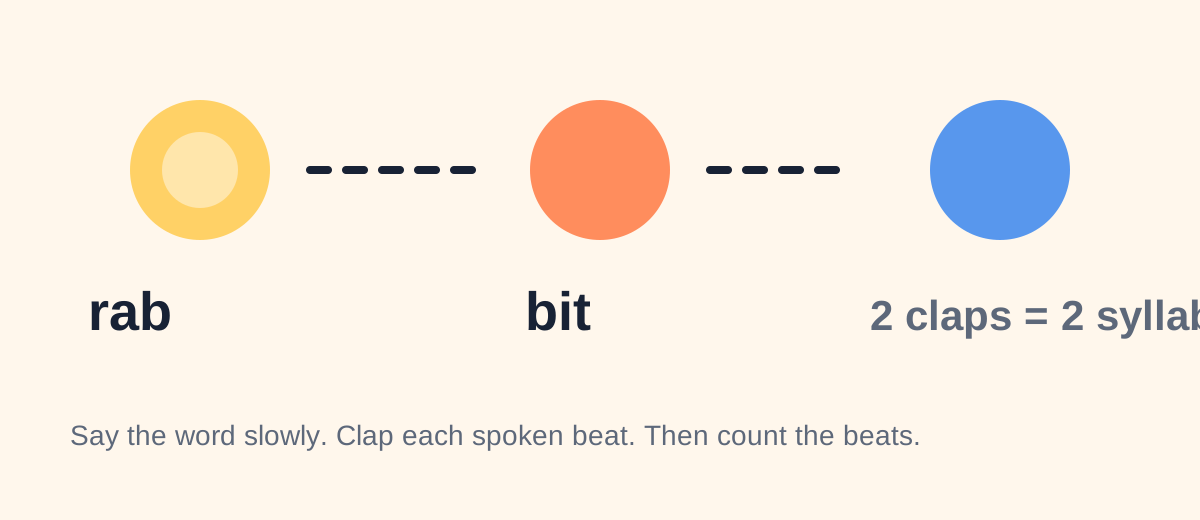
These terms sound similar, so it helps to keep them in order. Phonological awareness is the larger umbrella. It includes hearing rhymes, clapping syllables, noticing alliteration, and breaking spoken sentences into words. Phonemic awareness is one part of that umbrella: the part focused on the smallest sounds in words. Phonics connects those sounds to print.
| Skill | What the child works with | Example | Print needed? |
|---|---|---|---|
| Phonological awareness | Larger sound parts | Clap banana as ba-na-na | No |
| Phonemic awareness | Individual speech sounds | Blend /s/ /u/ /n/ into sun | No |
| Phonics | Sounds and letters | Read sun by matching s-u-n to /s/ /u/ /n/ | Yes |
Why phonemic awareness matters
Children need to understand that spoken words can be pulled apart into sounds and blended back together. Without that awareness, printed letters may feel like arbitrary marks. When a child knows that dog begins with /d/ and ends with /g/, the letter-sound connections in phonics make more sense.
Phonemic awareness also supports spelling. To spell mat, a child must hear /m/ /a/ /t/ in order. To change mat to sat, the child must notice that the first sound changed but the middle and final sounds stayed the same. This is the same kind of sound thinking used in CVC word reading and spelling.
Core phonemic awareness skills
Parents do not need a long technical checklist, but the main skills are useful to know. They usually move from easier listening tasks toward harder sound manipulation tasks.
| Skill | Parent prompt | Example answer | Why it helps |
|---|---|---|---|
| Sound isolation | What sound do you hear first in sun? | /s/ | Helps children notice beginning, ending, and middle sounds. |
| Blending | What word is /m/ /a/ /p/ ? | map | Builds the sound-to-word routine used in decoding. |
| Segmenting | Say the sounds in up. | /u/ /p/ | Supports spelling and sound-by-sound analysis. |
| Deletion | Say smile without /s/. | mile | Develops flexible sound manipulation. |
| Substitution | Change /t/ in top to /m/. | mop | Shows how one sound change creates a new word. |
A simple five-minute practice routine
- Start with listening. Say two words and ask whether they start with the same sound: sun and sit, or sun and map.
- Blend orally. Say /m/ /a/ /t/ with short pauses and ask, “What word?”
- Segment a short word. Say me, up, or sat, then ask for the sounds.
- Change one sound. Ask what happens if mat starts with /s/ instead of /m/.
- Connect to print briefly. If your child is ready, show the letters after the oral task and read the word.
Keep the routine short. Phonemic awareness practice should feel like a quick sound game, not a test. If the child is frustrated, return to easier tasks such as rhyming, clapping syllables, or listening for beginning sounds.
How phonemic awareness connects to phonics
Once a child can blend and segment spoken sounds, phonics gives those sounds printed symbols. The sound /m/ can be represented by the letter m. The sound /a/ in mat can be represented by the short vowel letter a. The sound /t/ can be represented by t. Together, those spellings create mat.
This is why phonemic awareness should not stay separate forever. Oral sound games are powerful, but children also need systematic phonics instruction that connects sounds to consonants, vowel sounds, spelling patterns, and decodable text. A strong reading app should support that bridge instead of only offering alphabet games or whole-word guessing.
Common mistakes parents should avoid
The first mistake is using letter names during a sound task. If the prompt is /m/ /a/ /p/, say the sounds, not “em ay pee.” Letter names matter later, but blending needs speech sounds.
The second mistake is adding extra vowel sounds to consonants. Try not to say /buh/ for /b/ or /tuh/ for /t/. Extra sounds make blending harder. Clean sounds help a child hear the real word.
The third mistake is making every task too difficult. Sound deletion and substitution are harder than blending and segmenting. If a child cannot blend /s/ /u/ /n/ into sun, do not start with advanced deletion tasks. Build from easier oral work toward harder manipulation.
A progression parents can follow
A simple progression keeps practice from becoming confusing. Start with larger sound parts, then move toward smaller ones. If your child can hear rhymes and clap syllables, try beginning sounds. If beginning sounds are easy, try oral blending. If blending is solid, try segmenting. Only after those are comfortable should you use harder tasks such as deleting or substituting sounds.
| Stage | Good task | Example | Move on when... |
|---|---|---|---|
| Rhymes and syllables | Hear larger sound patterns | cat/hat rhyme; clap ba-na-na | The child can hear and repeat patterns easily. |
| Beginning sounds | Listen for first phoneme | sun starts with /s/ | The child can identify first sounds in familiar words. |
| Blending | Combine sounds into a word | /m/ /a/ /p/ → map | The child can blend two- and three-sound words. |
| Segmenting | Pull a word apart | fish → /f/ /i/ /sh/ | The child can say sounds in order without adding extra sounds. |
| Manipulation | Change, delete, or substitute sounds | top with /m/ instead of /t/ → mop | The child can explain what changed. |
How this shows up in real reading
Phonemic awareness is invisible during fluent reading, but it supports the early work behind the scenes. A beginner who hears the three sounds in sat is better prepared to match those sounds to s-a-t. A child who can hear that ship has three sounds, not four, is better prepared to understand why sh works as one spelling for one sound.
It also helps with self-correction. If a child reads mat as map, ask them to check the last sound. That prompt directs attention to the spoken sound and the printed letter, instead of simply saying “try again.” Over time, children learn to check all the sounds in the word from left to right.
What to look for in a phonics app
If you are comparing apps, look for practice that includes oral sound work, clean pronunciation, blending, segmenting, and decodable words. The app should help children move from hearing sounds to reading words, not simply reward them for tapping pictures. Parent visibility also matters: you should be able to see what sounds and patterns were practiced.
When to ask for help
If your child cannot hear beginning sounds, cannot blend two- or three-sound words after repeated clear practice, or guesses words without looking at letters, ask the teacher what foundational skills are being taught and whether extra support is available. This article is educational information for parents and does not diagnose dyslexia, hearing issues, language delay, or any reading disorder.
Hooked on Phonics combines a clear learn-to-read sequence with short, guided lessons that fit into busy family routines. See current pricing and whether it matches your child's age.
We may earn a commission if you purchase through this link, at no extra cost to you. Read our affiliate disclosure.