Quick answer
Vowel sounds are open, voiced sounds that form the center of syllables. Beginning readers usually learn short vowels first in CVC words, then long vowels through silent-e, open syllable, and vowel-team patterns. Parents should teach vowel sounds in a clear sequence and connect them to blending, spelling, syllables, and decodable reading.
Key takeaways
- Short vowels are commonly taught first because they appear in many CVC and closed-syllable words.
- Long vowels often say the letter name, but they can be spelled in several ways such as silent e, vowel teams, and open syllables.
- Vowel rules are useful patterns, not absolute promises; teach one pattern at a time with examples.
- Vowel practice should connect hearing sounds with reading words, spelling, phrases, and meaning.
Vowel sounds are the open, voiced sounds that form the center of most English syllables. In school phonics, parents usually hear about the vowel letters a, e, i, o, u, and sometimes y. But the important reading idea is this: children need to connect vowel letters and vowel spellings with the sounds they hear inside words.
Vowels are often harder than consonants because one vowel letter can represent more than one sound. The letter a is different in cat, cake, ball, and about. That does not mean children should memorize random exceptions. It means vowel sounds should be taught in a clear sequence, with plenty of examples and decodable practice.
What are vowel sounds?
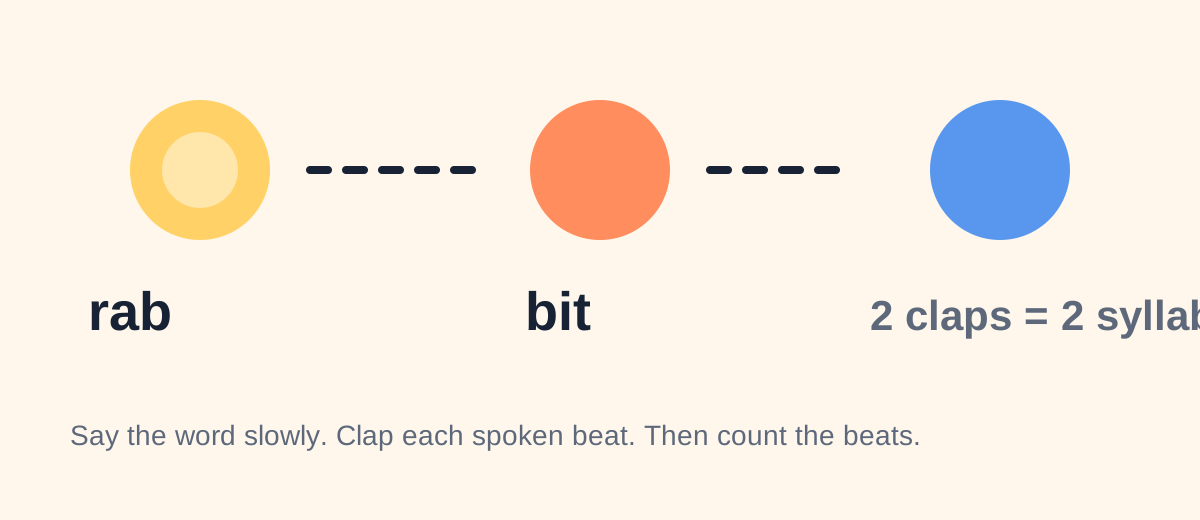
A vowel sound is made with a relatively open mouth and a voiced sound. Your tongue, lips, and jaw shape the sound, but the airflow is not blocked the same way it is for many consonant sounds. Every spoken syllable has a vowel sound or a vowel-like sound. That is why vowel practice connects closely to syllable counting.
For beginning readers, vowel sounds are usually introduced through short vowels first. These are the sounds children hear in words like cat, bed, sit, hop, and sun. Short vowels are useful because they appear in many simple CVC words, which are often the first real words children can decode independently.
Short vowel sounds
Short vowels do not say the letter name. They are quick sounds commonly found in closed syllables, where the syllable ends with a consonant. In the word cat, the vowel is followed by t, so the syllable is closed and the vowel is short. This pattern is not every English word, but it is a strong starting point for early phonics.
| Vowel | Short sound examples | Practice words | Parent note |
|---|---|---|---|
| a | apple, cat | mat, fan, bag, lap | Start with familiar words and avoid turning short a into the letter name. |
| e | egg, bed | pen, red, ten, web | Short e can be confused with short i; use clear minimal pairs. |
| i | insect, sit | pin, lip, dig, win | Keep the sound short and crisp before blending. |
| o | octopus, hot | hop, log, pot, mop | Pronunciation varies by accent; use the teacher's examples when possible. |
| u | umbrella, sun | cup, bug, run, mud | Many children need extra review because short u is less visually obvious. |
Long vowel sounds
Long vowels often “say the letter name,” such as long a in cake or long i in bike. This phrase is helpful, but it is not the whole system. Long vowel sounds can be spelled in several ways. A child may see long a in cake, rain, and day. A good phonics sequence introduces these spellings gradually instead of all at once.
One common long-vowel pattern is vowel-consonant-e, sometimes called silent e or magic e. Compare cap and cape. In cap, the vowel is short. In cape, the final e is silent, and the a is long. Similar pairs include kit/kite, hop/hope, and cub/cube.
Other vowel patterns parents will see
After short vowels and silent e, children meet vowel teams, r-controlled vowels, open syllables, and other patterns. A vowel team is a group of letters that work together for a vowel sound, such as ai in rain, ee in tree, or oa in boat. R-controlled vowels happen when r changes the sound, as in car, her, bird, corn, and turn.
Open syllables also matter. In an open syllable, the vowel ends the syllable and is often long, as in me, go, or the first syllable of tiger. This is one reason syllable knowledge helps children read longer words: they learn to test vowel sounds by looking at the syllable pattern.
A simple teaching sequence for parents
- Start with one short vowel. Use a small set such as mat, sat, fan, and bag. Do not mix all vowels immediately.
- Blend with known consonants. Choose words made from sounds the child already knows, so the lesson is about the vowel, not every letter at once.
- Sort by sound. Ask whether words belong with short a, e, i, o, or u. Say the words aloud before reading them.
- Compare short and long pairs. Once short vowels are stable, compare cap/cape, kit/kite, and hop/hope.
- Read in phrases. Move from word lists into phrases such as a red hen, the hot sun, or I can ride.
If your child uses a reading app, choose one that teaches vowel sounds in a sequence and gives decodable practice, not just alphabet songs or fast flashcards. You can compare parent-friendly options in our best phonics app reviews.
Common vowel mistakes
The first mistake is teaching vowel rules as if they are absolute. Rules such as “silent e makes the vowel long” are useful, but English has exceptions and advanced patterns. Say “often” or “usually” when appropriate, and focus on the pattern being taught.
The second mistake is jumping into long vowels too quickly. If a child is still unsure about short vowels in CVC words, long-vowel patterns may increase guessing. Strengthen short vowels first, especially short e vs short i, because those sounds are easily confused.
The third mistake is separating vowel practice from meaning. Children should blend the word, say it normally, and use it in a phrase or sentence. Reading is not only sound production; the word should make sense in language.
Vowel sounds and sight words
Many sight words contain regular consonants but less predictable vowel spellings. The word said has a tricky vowel spelling, but the /s/ and /d/ are useful anchors. The word like becomes more decodable once a child learns the silent-e pattern. Instead of telling children every common word is a shape to memorize, help them map the regular parts and mark the tricky vowel part.
Five-minute vowel practice routine
- Hear it: say three words and ask which vowel sound is the same.
- Build it: use letter tiles to build a short-vowel word such as map.
- Change it: swap the vowel to make mop or mug.
- Read it: blend the sounds and say the word naturally.
- Use it: read a short phrase or make a silly sentence.
How vowel sounds support spelling
Vowel instruction should support spelling as well as reading. When a child spells cap, the child has to hear /k/ /a/ /p/, choose the short-a spelling, and place the letters in order. When the word changes to cape, the child has to notice that the final e changes the vowel pattern. Reading and spelling practice together makes the pattern more durable.
For older beginners, compare word families and syllable types. Sort cat, cap, and can as short-a closed-syllable words, then compare them with cake, came, and cane. Ask the child to explain what changed in the spelling and what changed in the vowel sound. This kind of brief explanation helps children become flexible decoders instead of memorizing isolated lists.
When to ask for help
If your child consistently confuses vowel sounds after repeated explicit practice, guesses from the first letter, or cannot blend simple words with known sounds, ask the teacher what phonics sequence is being used and whether extra support is available. This guide is educational information for parents and does not diagnose dyslexia, hearing issues, speech-language delay, or any reading disorder.
Hooked on Phonics combines a clear learn-to-read sequence with short, guided lessons that fit into busy family routines. See current pricing and whether it matches your child's age.
We may earn a commission if you purchase through this link, at no extra cost to you. Read our affiliate disclosure.