Quick answer
Phonemic awareness is the ears-only ability to hear and manipulate individual sounds in spoken words, while phonics connects those sounds to printed letters so children can read and spell. Children need both, with sound awareness supporting letter-sound learning, and parents who understand the distinction can choose better apps, books, and home activities.
Key takeaways
- Phonemic awareness is about sounds only, with no print; phonics connects sounds to letters.
- Many products labeled "phonics" teach neither skill — check what the child actually does.
- Sound awareness supports phonics; practice oral blending before or alongside letter work.
- Use short, playful no-print sound games and print-based word building at home.
- Look for apps and programs that bridge ears to eyes: oral sound work plus decodable reading.
In short: Phonemic awareness is the ability to hear and play with individual sounds in spoken words — no letters, no print. Phonics is the step that connects those sounds to printed letters. Children need both, in roughly that order: sound awareness first, then letter–sound connections. Keep that single distinction in mind and you will make far better choices about apps, books, and practice activities.
The difference in one sentence — and one table
Here is the shortest accurate explanation. Phonemic awareness is ears-only work: hearing that map is made of /m/ /a/ /p/, noticing that changing /m/ to /t/ makes tap, and doing it all with no letters on the page. Phonics is eyes-and-ears work: knowing that the letter m represents /m/, that the letter a in a closed syllable usually represents the short /a/ sound, and using that knowledge to read the printed word map. The confusion is completely understandable: the terms sound alike, they are often taught in the same lesson, and app stores use the word "phonics" to describe almost everything with letters in it.
| Aspect | Phonemic awareness | Phonics |
|---|---|---|
| What the child works with | Individual speech sounds (phonemes) | Sounds paired with printed letters and spellings |
| Print involved? | No — eyes can be closed | Yes — always involves letters |
| Typical task | Blend /s/ /u/ /n/ into the spoken word sun | Read the printed word sun by matching s-u-n to /s/ /u/ /n/ |
| What changes when one unit changes | Swapping a sound makes a new spoken word (map → tap) | Swapping a letter makes a new printed word (map → tap) |
| Taught through | Sound games, clapping, chanting, oral prompts | Letter tiles, decodable books, writing, word building |
| The question it answers | "What do you hear?" | "What sound does this letter make, and what word do these letters spell?" |
A quick map: where these skills sit
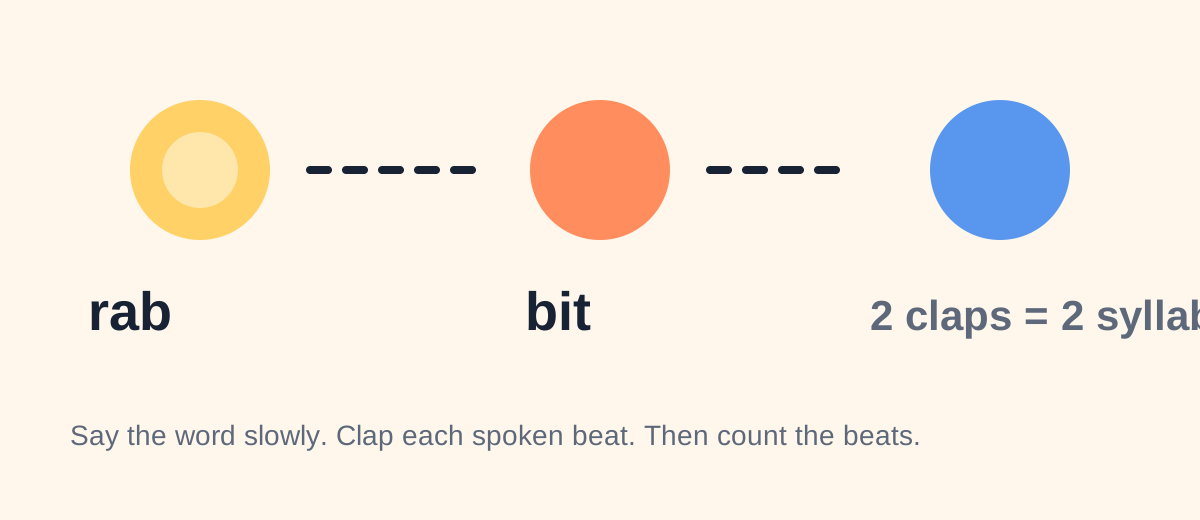
Phonemic awareness belongs to a bigger family called phonological awareness — the umbrella term for noticing sound structure in spoken language. Under that umbrella you find rhyming, clapping syllables, hearing alliteration, and, at the most advanced tip, phonemic awareness: working with individual phonemes. Phonics sits outside that umbrella entirely, because phonics is about print. This is why researchers describe phonemic awareness as a predictor of reading progress rather than reading itself: it prepares the ear, and phonics puts the eye to work on what the ear has learned. If you want a deeper tour of the sound skills themselves, our guide to phonemic awareness walks through blending, segmenting, and the other core tasks.
Why this confusion costs parents money
Walk through any app store and you will find dozens of products labeled "phonics." Many of them are not really teaching phonics at all — and some are not teaching phonemic awareness either. Knowing the distinction turns you into a much sharper shopper, because you can look past the label and ask what the child is actually doing. Most early-literacy apps fall into one of four buckets.
- Alphabet and letter-name apps. The child matches uppercase to lowercase letters, taps the letter that says its name, or sings the alphabet song. Useful for letter recognition, but this is neither phonemic awareness nor phonics.
- Whole-word memorization apps. The child sees a word, hears it, and taps the matching picture. The child is memorizing word shapes rather than learning how letters represent sounds.
- Oral sound games. The child blends spoken sounds, finds rhymes, or taps the picture that starts with /m/. This is genuine phonemic awareness practice — valuable, but it stops before print.
- Systematic phonics programs. The child learns letter–sound correspondences in a planned order, blends sounds into printed words such as mat and pin, and reads short decodable text using only the patterns taught so far. This is the only bucket that carries a child from sounds to real reading.
Before you pay for a subscription, open the app's description or its free trial and check for the markers that matter: oral blending and segmenting games (phonemic awareness), clean letter–sound teaching, blending of printed words, and decodable sentences rather than picture-guessing. Our roundups of apps for struggling readers and free phonics apps use exactly these criteria, and you can compare phonics apps side by side to see which ones cover both sides of the bridge.
When each skill develops
Children do not learn these skills on a fixed timetable — there is wide, normal variation — but researchers describe a rough order in which sound skills tend to appear. Use this as a map, not a deadline.
| Rough stage | Phonemic awareness milestone | Phonics milestone |
|---|---|---|
| Around ages 3–4 | Enjoys rhymes and alliteration; claps syllables in familiar words | Recognizes some letter names; may "read" familiar logos from memory |
| Around ages 4–5 | Hears first sounds in words; blends simple spoken words like /s/ /u/ /n/ | Connects a few letters to their sounds; tries to write with invented spelling |
| Around ages 5–6 | Segments short spoken words; plays with changing one sound | Blends printed consonant-vowel-consonant words; reads short decodable sentences |
| Around ages 6–7 | Manipulates sounds mentally (say smile without /s/) | Reads longer patterns such as digraphs and vowel teams with growing independence |
Notice that the two columns run side by side rather than strictly one-after-the-other. A four-year-old can be learning letter sounds while still strengthening oral blending, and a six-year-old can still benefit from quick sound games. The important point is the direction: phonemic awareness supports phonics, and phonics makes phonemic awareness useful for real reading.
Five no-print activities for phonemic awareness
These work anywhere — in the car, at the dinner table, on a walk — because nothing needs to be written down.
- Same-sound sorting. Name three things you can see: "sun, sock, map. Which two start with the same sound?" Let your child point and say the sound.
- Robot talk. Speak like a robot: "/d/ /o/ /g/." Your child blends the sounds and shouts the word. Take turns being the robot.
- Say it without. "Say smile without /s/." Start with easy deletions at the beginning of words before trying middle or ending sounds.
- Sound stepping. Take one step for each sound you hear in a short word: up gets two steps, me gets two steps, sat gets three.
- Rhyme time in the car. "I'm thinking of something that rhymes with car..." Rhyming builds the ear for sound patterns long before letter work begins.
Keep it to five or ten minutes and stop while it is still fun. If your child struggles, drop back to easier tasks like rhyming rather than pushing harder manipulation games.
Five print-based activities for phonics
Once your child knows a few letter sounds, connect them to print with these simple routines.
- Magnetic letter word building. Build mat on the fridge, read it together, then swap the m for s and read the new word. Changing one letter shows how print maps to sound.
- Letter–sound matching. Lay out a few letters your child has learned and ask for the one that makes /t/, not the one named "tee."
- Read-it-left-to-right. Point under each letter of a short word, say the sounds, and blend them. Our CVC word guide has word lists organized by short vowel for exactly this practice.
- Sound boxes with letters. Draw three boxes, place one letter in each, and slide a finger under them while saying the sounds — the same motion used in blending practice.
- Write it, then read it. Say a word slowly, let your child write the letters they hear, then read the word back together. Spelling and reading strengthen each other.
How to tell what your child is really practicing
During homework time or app time, watch for one minute and match what you see to this quick checklist.
| What you see | What is really being practiced |
|---|---|
| Child closes eyes, listens, and says or changes sounds | Phonemic awareness — genuine ear work |
| Child looks at letters, says their sounds, and reads a word | Phonics — the sound-to-print connection |
| Child names letters ("em-ay-pee") instead of saying sounds | Letter-name knowledge — a different, earlier skill |
| Child says the word after glancing at the picture | Whole-word guessing — neither skill, and worth redirecting |
| Child taps the matching picture when the app says a word | Vocabulary or word recognition — useful, but not decoding |
The bridge between the two
Neither skill is enough on its own. Phonemic awareness without phonics produces a child who can play brilliant sound games but cannot read a book. Phonics without phonemic awareness is possible but much harder — the child is asked to connect sounds to letters before being sure what the sounds are. The strongest practice builds an explicit bridge: one minute of oral blending ("What word is /m/ /a/ /t/?"), then the same word in print ("Now read mat"). When you shop for programs or plan home practice, look for that handoff. The tools that move children deliberately from ears to eyes are the ones that turn early sound play into real reading.
Frequently asked questions
Is phonemic awareness the same as phonics?
No. Phonemic awareness is hearing and playing with individual sounds in spoken words, with no print involved. Phonics connects those sounds to printed letters so children can read and spell words.
Which should my child learn first?
Sound awareness supports phonics, so oral sound play is a natural starting point — but the two can overlap. The key is not to skip the ear work for a child who cannot yet blend spoken sounds.
If my child already knows letter sounds, do we still need phonemic awareness?
Check first. Ask your child to blend spoken sounds with no letters: "What word is /s/ /u/ /n/?" If that is easy, the foundation is probably solid and you can focus on print.
How can I tell whether an app teaches phonemic awareness or phonics?
Look at what the child does. Oral blending and segmenting games with no letters on screen are phonemic awareness. Letter–sound matching, word building, and reading decodable words are phonics.
How much time should we spend on each?
Five to ten minutes of playful sound work a day is plenty for most young children — consistency matters more than length. If your child struggles despite steady practice, talk with the teacher.
Sources and further reading
For the research background on phonological and phonemic awareness, see Reading Rockets' guide Target the Problem: Phonological and Phonemic Awareness, which covers definitions, developmental milestones, and home activities. For classroom-style resources organized by taught skill, including decodable passages and structured practice, see the UFLI Foundations Toolbox. The tables, activity lists, and shopping checklist in this guide are our editorial synthesis. This article offers educational information for parents, not a diagnosis of any reading difficulty.
Hooked on Phonics combines a clear learn-to-read sequence with short, guided lessons that fit into busy family routines. See current pricing and whether it matches your child's age.
We may earn a commission if you purchase through this link, at no extra cost to you. Read our affiliate disclosure.